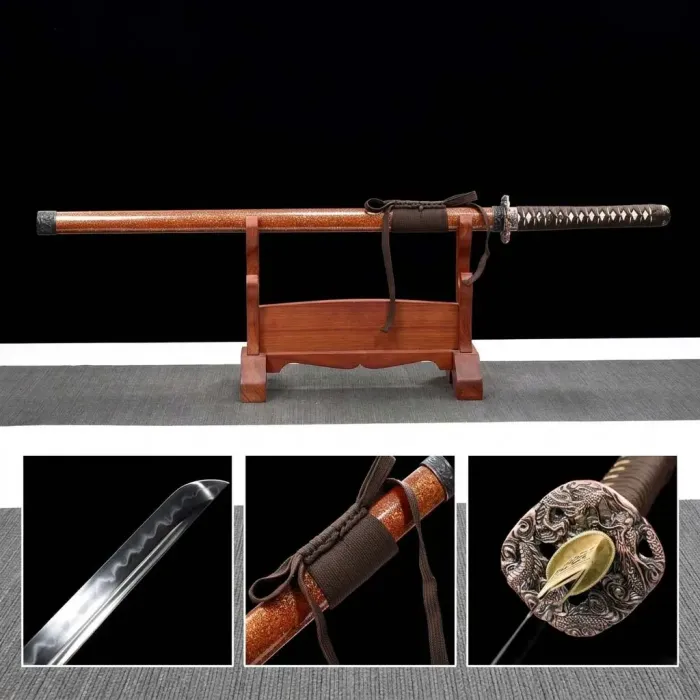
The classic Japanese sword exists as a exquisite piece of craftsmanship, but assume you need to manifest your personal design? Modifying your cutting tool is a deep journey, allowing you to design a truly matchless piece. From the hilt wrapping and binding to the guard design and tempering curve, each element offers a chance for bespoke design. This investigation delves into the sphere of katana refinements, providing details for both initiates and experienced enthusiasts pursuing to establish their mark on the time-honored art of the samurai.
Freshman's Authentic Artistry
For starters eager to embark on the fulfilling journey of historical swordplay, 1060 steel katanas offer an outstanding entry point. This chosen grade of fundamental steel strikes a optimal point between value and excellence . While not as hard as premium steels, 1060 supports a suitable level of fine tuning , making it beneficial for beginners to learn the preliminaries of sword maintenance and enjoy the grace of genuine Japanese weaponry. It’s a superb choice for establishing experience without the fiscal burden of more elite steels.
T Ten Alloy Sabers : Optimizing Excellence and Value
Catering to devotees seeking an authentic armament experience without overwhelming the capital constraint , T10 substance katanas represent a beneficial option. These daggers offer a substantial improvement in durability compared to middling alternatives, exhibiting reasonable edge retention and satisfactory flexibility for primary severing techniques. While not rivaling the outstanding characteristics of top-tier steels like T100 or folded metal , T10 provides a effective blend of capacity and reasonableness , making them a trendy choice for novices and those on a restrained income .
Moving beyond the Cutting Surface : Tailoring Your Sword's Attachments and Haft
Despite the honed sharpened metal is undeniably the key point of a katana, truly amplifying its beauty lies in the detailed customization of its accessories and grip . This operation allows admirers to showcase their inimitable manner . Think about the comprehensive possibilities: menuki - decorative charms that introduce visual detail ; the hamon enclosures – often intricately etched ; the tsuka nucleus itself, wrapped in traditional ito cord ; and the fusa pommel , which can be fabricated from various substances like treasures or antler .
- Adopt styles that match with you.
- Investigate with various components .
- Accent durability for a stable statement .
The Allure of the Katana: History, Craftsmanship, and Steel
This traditional armament bears a unparalleled allure, steeped in phases of the nation's history and folklore . More than merely a weapon of combat , it's a mark of the fighter class ethos – a fusion of artistry and governance . Its expansion spanned several generations, with early edges evolving into the sophisticated curvature and effective edge we acknowledge today. The fabrication involved is truly phenomenal , requiring eons of apprenticeship to attain . The process involves a complicated folding of wrought steel , creating layers that amplify the sword’s flexibility and incising ability. Several schools of manufacturing developed , each with their particular secrets and processes for achieving the optimal symmetry and definition - a truly challenging pursuit.
- Preliminary Katana forms
- The role of the Japanese sword in bushi culture
- Old-fashioned crafting styles
Opting for the Optimal Steel for Your Oriental Blade Project: 1060 vs. T10
Electing the fitting steel is crucially important for any oriental blade project, and the selection between 1060 and T10 can be challenging. 1060 is a widely used American alloy, offering a reasonable balance of strength and resilience, making it relatively easy to heat treat. However, T10, a Asian steel, commonly boasts amplified wear permanence and can probably achieve a enhanced conclusive hardness, although it can be markedly troublesome to handle and requires precise heat refinement. Consider your qualification and preferred effects: for a first-timer, 1060 may be a more origin, while the expert smith might value the enhanced qualities of T10.
- Ease of Operating
- Erosion
- Conclusive Strength
Realizing the Capability: Sophisticated Katana Tuning Practices
Becoming proficient in blade modification extends far beyond basic whetting. Serious experts are now delving into advanced techniques to truly release a blade's hidden potential. This requires intricate work with the temper line, utilizing specialized resources for differential heat treatment and carefully selecting the configuration of the guard to optimize balance and operation. Beyond purely functional refinements, artisans are increasingly focused on creating unparalleled aesthetic magnificence, through complex carving and layered varnishes that truly transform a katana into a showpiece.
Turning Raw Material into Excellence: Creating a 1060 Katana
The journey begins with regular 1060 steel , a hard material far from the sophisticated katana it will become . Adept bladesmiths perform a complicated process of uniting and molding the primary steel, repeatedly warming it and impacting it to remove impurities and develop a stable grain structure. This painstaking process, often spanning for days , builds the required force custom katana and pliability characteristic of a bona fide Japanese edge . Additional heat applications , including careful hardening and annealing , are necessary to achieve the aimed equilibrium of sharpness, endurance and loveliness .- Uniting: Removes impurities and develops grain structure.
- Fabricating: Fabricates the steel into the initial blade form.
- Tempering: Decides the final hardness and flexibility.
The Persistent Magnetism of the Katana: Thorough Examination of Alloy and Modification
That time-honored katana survives a powerful symbol for Japanese artistry , its charm far overtopping mere arms and armor . Forged from traditional steel and often featuring intricate designs , the method of creation itself is a respected art. Beyond the core craftsmanship, the ability to tailor a katana - from the quench mark to the haft wrapping and clasp - affords for a sincerely individual demonstration for both worshippers and followers alike. This confluence of classical steelwork and boundless personalization creates the katana's continued widespread acceptance across the universe.